
Ecommerce shipping best practices, from someone who broke most of them first
 Verified & Reviewed


 Copy Link
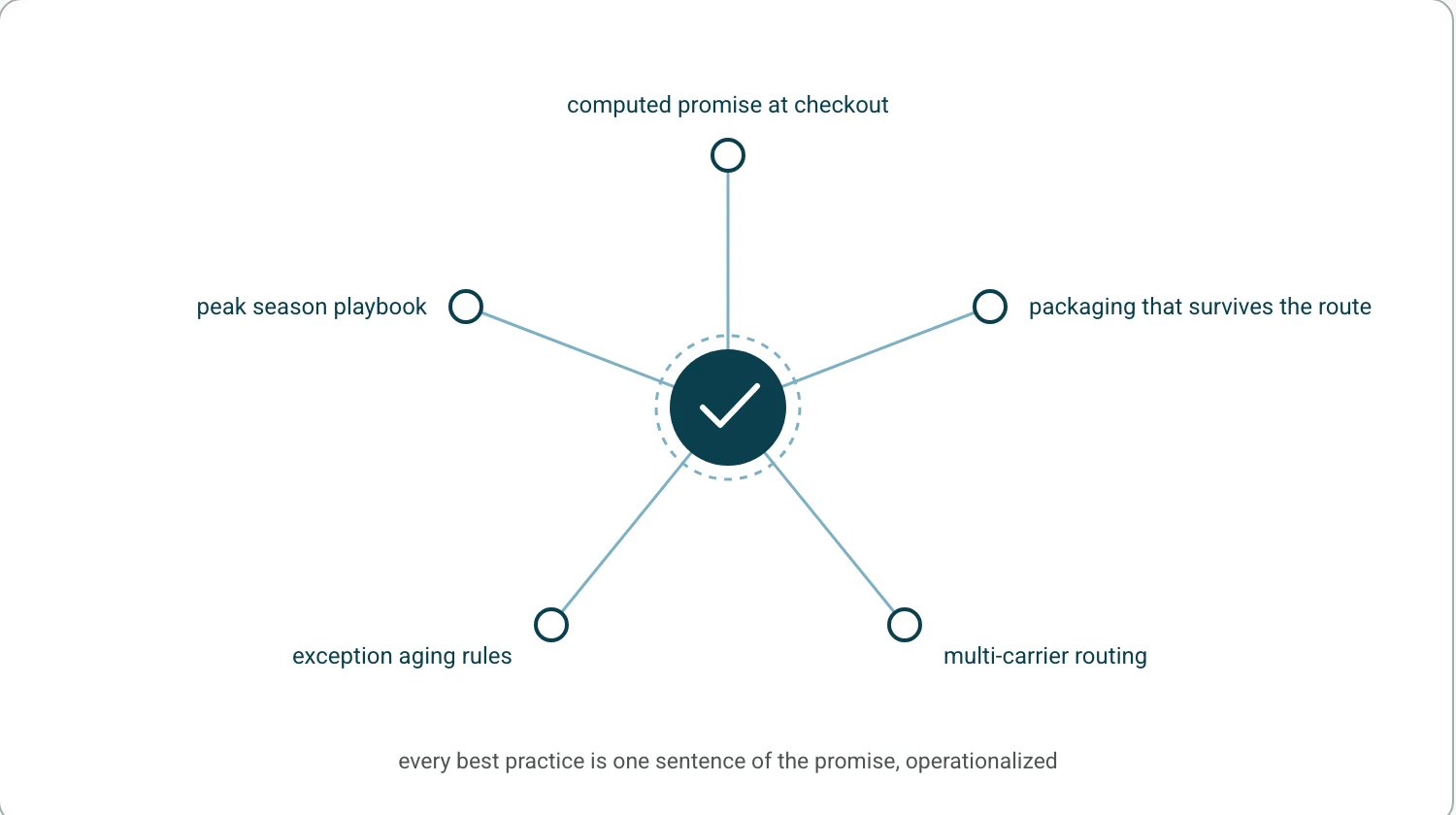
Ecommerce shipping best practices are the operating habits that keep delivery fast, margins intact, and support queues quiet: computed delivery promises, right-sized packaging, multi-carrier routing, daily exception review. Plenty of pages will give you that list. What I can add, after two decades running the brands where these lessons got expensive, is which practices actually carry the weight, and the one practice underneath all of them. Every order is a promise. Keeyu keeps it, and every best practice on this page is in service of that single sentence. That is the lens of proactive e-commerce operations, the system of action for e-commerce: shipping is not a cost center to optimize, it is a promise-keeping machine to instrument.
Protect the margin before you optimize the speed
- Right-size packaging. Dimensional weight surcharges are the quietest margin leak in shipping. Audit your five most-shipped SKUs against the box they actually go in.
- Set free-shipping thresholds above AOV. Fifteen to twenty percent above, so the threshold pulls baskets up rather than subsidizing orders you already had. Recheck quarterly against real carrier cost.
- Price the promise, not just the parcel. I built a subscription strategy at SurfStitch that put priority shipping behind a membership: delivery speed is a product you can sell, not only a cost you eat. Whatever you charge, the computed date at checkout, covered on the delivery promise page, is what converts.
Do the same for the reverse leg: reverse logistics software is the returns-side equivalent of everything in this section.
Carriers and 3PLs: trust, but instrument
Run more than one carrier once volume allows, route by lane performance, and measure each against your promise rather than their published SLA, using the metrics on the on-time delivery page. And instrument the connection itself, because the integration is a failure point of its own. At Papinelle we lived the nightmare version: a US 3PL integration that would silently break, so sales stopped invoicing for days, and we would only discover it midweek after a weekend of orders, then chase the fix across a 24-hour time difference. The lesson was not "that 3PL was bad." The lesson was that no system in our stack owned noticing. We also learned the cost math cuts both ways: we eventually consolidated storage back in-house because the 3PL was costing more than running it ourselves. The right answer depends on your volume and SKUs, but it should be an answer you recalculate annually, not a decision you made once. The full stack view is on the order fulfillment system page.
Instrumenting means counting checkpoints, not carriers. We track roughly thirty to thirty-five checkpoints between the order being placed and the parcel arriving, and the useful ones are the boring internal handoffs: paid to processed, processed to picked, picked to manifested, manifested to first scan. I gave that number on The Ecommerce Edge. A carrier scorecard starts at the first scan, which means it grades the last third of a journey you may already have lost.
Peak season: prepare the failure paths
Peak does not invent new failure modes, it multiplies your existing ones. At P.E. Nation a Black Friday glitch oversold more than a thousand items, and the recovery cost was seven new hires whose job was apologizing, a story I unpacked in full on Add To Cart. And know your 3PL's peak reality, which is all through the 786 pain points we mined from 270 customer call transcripts between May 2025 and May 2026: during Black Friday-scale events, 3PLs can halt shipping for days, creating massive backlogs while the merchant sits completely in the dark, and system sync failures in the same week can leave zero order visibility with hundreds of unshipped orders nobody can see. Decide the oversell playbook before November: detection threshold, bulk-communication templates from the shipping notifications playbook, refund authority. And be careful what you automate at the front door: one retailer had 60 percent of tickets flowing through helpdesk AI, and over peak it snowballed, because the AI only escalated angry customers while the polite ones churned silently. They pulled it back to 10 percent. Automation at the complaint end scales the apology. The automation that pays at peak sits at the detection end, before the complaint exists.
Watch what peak does to your headcount plan before it does it. One of our customers runs twenty customer service people year round and scales to forty for the two months around peak, which I mentioned on eCommerce Australia. That second twenty is the price of a failure path nobody automated. Every peak-only hire is a permanent operational defect wearing a seasonal costume.
The practice under all the practices
Every habit above shares one dependency: knowing, order by order, whether the promise is still on track. Age your exceptions daily. Track promise-kept rate as a first-class metric alongside the measures on the customer satisfaction metrics page. And put something in the stack whose only job is watching every order against the date it was sold with, across storefront, warehouse, 3PL, and carriers, and acting when one drifts. Detect. Decide. Act. That is what Keeyu does, and it is the practice that turns the rest from folklore into a measured system. Keeyu gets shoppers what they want, on time, as promised. The wider discipline is on the post-purchase operations hub, and a demo will show you which best practices your orders are actually breaking. Every order is a promise. Keeyu keeps it. Best practice is just that sentence, operationalized.
Write the promise down as data before you optimize anything against it. Ours reads: order before twelve, pay for express, ships same day, arrives tomorrow, which is how I put it on Add To Cart. A practice you cannot express that precisely is a preference. The ones you can are the only ones an operation can be held to.
Frequently Asked Questions
What are the most important ecommerce shipping best practices?
Set a promise you can compute, protect margin with right-sized packaging and free-shipping thresholds set above AOV, run more than one carrier, age your exceptions daily, and watch every order against the date it was sold with. The last one makes the others measurable.
How do I set a free shipping threshold?
Above your average order value, typically 15 to 20 percent above, so the threshold pulls baskets up instead of giving shipping away on orders you were getting anyway. Then check it quarterly against real carrier cost per order.
Should I use one carrier or several?
Several, once volume allows. A single carrier is a single point of failure and a single negotiating position. Route by lane performance and cost, and measure each carrier's on-time rate against your promise, not their published SLA.
How should I prepare shipping for peak season?
Prepare the failure paths, not just the capacity. Pre-agree carrier cutoffs, stress-test your 3PL connection, decide your oversell playbook in advance, and have bulk customer-communication ready. Peak does not create new failure modes, it multiplies your existing ones.
References
- Keeyu customer results: keeyu.com/customer-stories
- The Breakout CEO #86, The Pivot This Founder Made After an Investor Called It Impossible - one in five US shoppers not getting orders on time, and the ticket ratios behind it.
- Marketing for SMEs, Jevon Le Roux on the E-Commerce Mistake Costing Millions - the orchestration layer, and the 55% ticket cut at EHP Labs.
Ready to Stop Reacting?
The fastest way to see how Keeyu prevents complaints is to see it in action.
In one call, we’ll map your current operations, show how our AI Agent fits in, and walk through real examples of issues fixed before customers notice.
Most teams go live within 48 hours. We never share your data.

