
The delivery promise: set it, show it, keep it
 Verified & Reviewed


 Copy Link
A delivery promise is the commitment your checkout makes about when the order will arrive: an exact date, a window, or a cutoff like "order before 12, ships same day." Two things are true about it. Showing an exact date lifts conversion, because shoppers buy certainty. And an exact date is exactly breakable. This page is the closest thing to the center of everything I believe about ecommerce, so I will say it plainly. Every order is a promise. Keeyu keeps it. Not as a slogan, as an operating principle: the promise made at checkout is the standard every warehouse, carrier, and support decision downstream should be measured against. That is the whole logic of proactive e-commerce operations, the system of action for e-commerce.
Set it: a promise you can compute
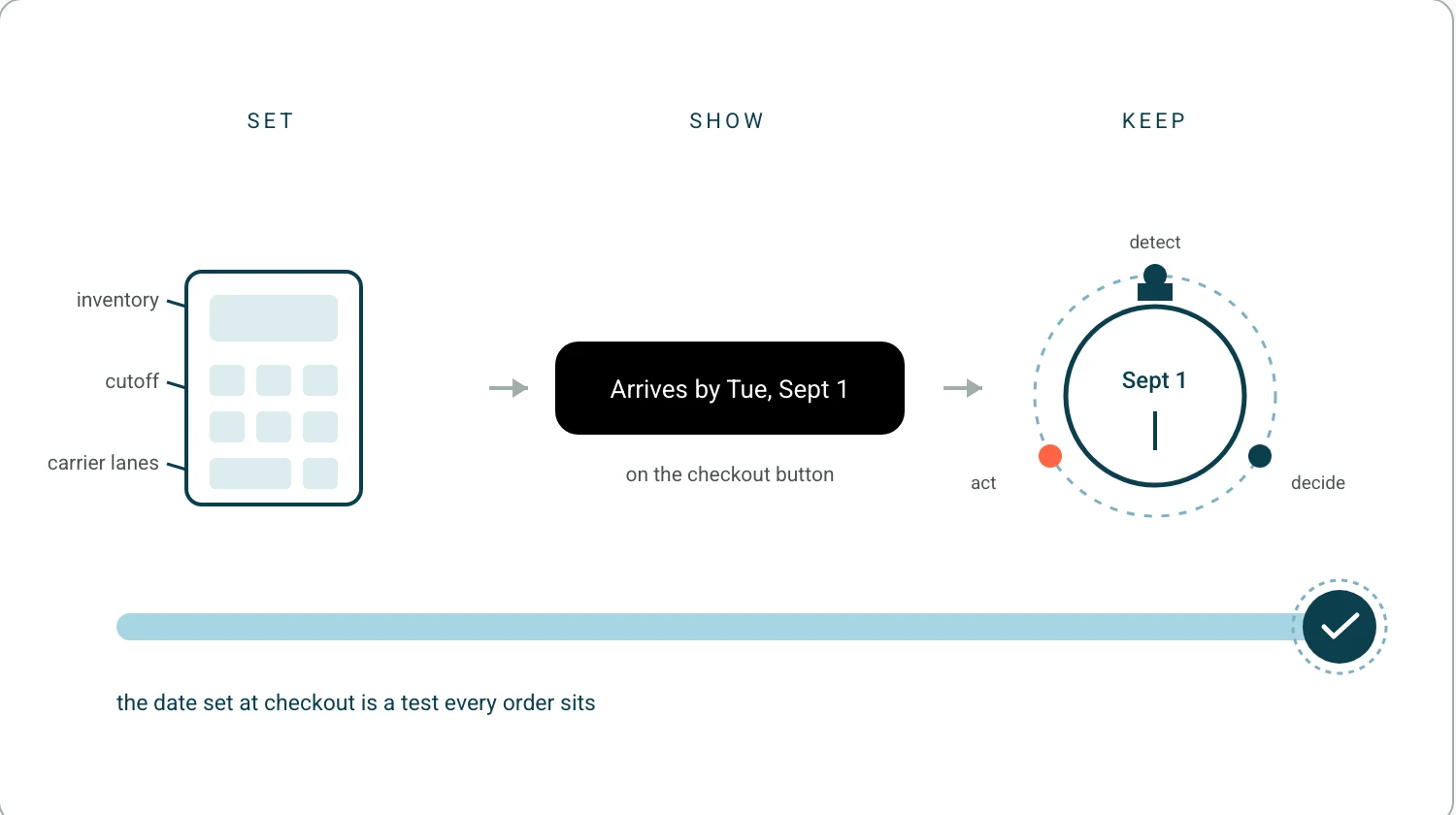
In the US the promise is not only a marketing claim, it is a legal one: the FTC's Mail, Internet, or Telephone Order Merchandise Rule requires a seller to have a reasonable basis for the shipping time it states, and to notify the buyer when it slips. A real delivery promise is calculated, not copywritten. Three inputs, all live: inventory (is the item actually allocatable now), warehouse cutoffs (what does "today" still mean for dispatch), and carrier performance by lane (what does this carrier actually do to this postcode, not what their rate card says). SLAs stack in layers: dispatch cutoffs, carrier commitments of 24 to 48 hours or five business days, marketplace SLAs above those. A promise engine that ignores a layer produces dates your operation never had a chance to keep. If your dates come from a static shipping-settings table, you are not promising, you are guessing in the customer's direction.
Get this wrong repeatedly and it compounds into the pattern described on poor customer experience: not one bad delivery, but a brand people stop trusting with time-sensitive orders.
There is a reason this is the promise worth computing rather than any other. About half of every support queue is a version of where is my order, a share I gave on The Breakout CEO. That queue is not asking about your product or your policy. It is asking whether the date you put on the page still holds.
Show it: the conversion case
"Arrives by Tuesday" beats "ships in 3-5 business days" at checkout, and the conversion data across the industry backs it consistently. But understand the trade you are making: you are converting uncertainty into accountability. The vague range was unfalsifiable. The date is a test your operation sits every single order. It is also what makes the aggressive checkout promise safe to run: "order before 2pm, pay express, get it tomorrow" is only a conversion weapon when every order is visibly tracking against that promise. That trade is worth making, on one condition: something downstream has to be watching every order against the date you showed. Which brings me to the part most delivery-promise content skips.
Keep it: the machinery behind the date
Leadership teams walk into diagnostics confident they run proactive operations, and the data routinely shows them firefighting 85 percent of the time, with WISMO dominating the queue. The promise was shown at checkout, and then nobody owned it, which is exactly the reactive tax in one sentence. Keeyu was founded on the other side of this: a warehouse sale at P.E. Nation in 2020 where stock issues surfaced only after customers complained. The rebuild taught me what keeping promises does to a team, not just to customers: when we gave the customer service team real-time issue detection at P.E. Nation, engagement jumped, because the job stopped being firefighting and became keeping promises on purpose. The mechanics are on the on-time delivery page: track every order against its specific promise, catch the drift early, act while there is still time to keep the date, and when it truly cannot be kept, tell the customer first with a new date. What each failure mode means is on the delivery exception page.
The promise has to be written down as data before anything can keep it. Ours reads: order before twelve, pay for express, ships same day, arrives tomorrow. Every order is then scored against it and colored blue, amber or red, and amber is where a workflow fires, because that is the last point where the fix still beats the complaint. I described the model on Add To Cart.
The promise is the product
A GP at Emergence Capital described the opportunity we spent two years grinding toward better than we had: the biggest CX AI opportunity is beyond chatbot deflection, into proactive intelligence. Deflection manages the complaint about a broken promise. Proactive intelligence keeps the promise so the complaint never exists. That is the category line, and I have argued it in public on Add To Cart. It is why the promise engine and the helpdesk are not competitors: one calculates the date, the other apologizes for it, and the layer in between, detect, decide, act, is the one that determines which of them matters. Keeyu gets shoppers what they want, on time, as promised. The stack view lives on the order fulfillment system page, the whole discipline on the post-purchase operations hub, and your own promise-kept rate is one demo away. Every order is a promise. Keeyu keeps it. That is the entire company in six words, and this page is the keyword it lives on.
There are two ways a promise fails and only one of them arrives in your inbox. Some shoppers call and become a ticket. The others say nothing, and they are the ones who leave, which is how I put it on The Breakout CEO. A promise-kept rate counts both. A satisfaction score can only ever count the first.
Frequently Asked Questions
What is a delivery promise in ecommerce?
The commitment shown at checkout about when the order will arrive - an exact date, a window, or a cutoff like "order before 12, ships same day." It is the standard every downstream system will be judged against.
Do exact delivery dates increase conversion?
Showing a specific arrival date instead of a vague range measurably reduces cart abandonment - shoppers buy certainty. The catch: a specific promise is also specifically breakable, so the operational side has to be able to keep what the checkout shows.
How do brands calculate a delivery promise?
By combining live inventory, warehouse cutoff times, and real carrier performance by lane. A promise engine that ignores any of the three produces dates the operation cannot keep.
What should happen when a delivery promise is about to be missed?
The brand should know before the customer does: detect the order drifting off its promise, fix what can be fixed, and tell the customer first with a new date. A missed promise the brand announces reads completely differently from one the customer discovers.
References
- Keeyu customer results: keeyu.com/customer-stories
- The Breakout CEO #86, The Pivot This Founder Made After an Investor Called It Impossible - one in five US shoppers not getting orders on time, and the ticket ratios behind it.
- Marketing for SMEs, Jevon Le Roux on the E-Commerce Mistake Costing Millions - the orchestration layer, and the 55% ticket cut at EHP Labs.
Ready to Stop Reacting?
The fastest way to see how Keeyu prevents complaints is to see it in action.
In one call, we’ll map your current operations, show how our AI Agent fits in, and walk through real examples of issues fixed before customers notice.
Most teams go live within 48 hours. We never share your data.

