
Order fulfillment system: the pieces, and the layer nobody owns
 Verified & Reviewed


 Copy Link
An order fulfillment system is everything between "placed" and "delivered": the order management system (OMS) that orchestrates orders across channels, the warehouse management system (WMS) or 3PL that picks and packs, the carriers that deliver, and the integrations wiring them to your storefront. Searchers using this phrase are usually deciding between running their own system and outsourcing it. My position after two decades inside these stacks: whichever way you build it, the system you assemble will have no component whose job is the promise. Every order is a promise. Keeyu keeps it, and the reason that sentence needed to exist is that OMS, WMS, and 3PL each own a stage, and no stage owns the outcome. That missing layer is proactive e-commerce operations, the system of action for e-commerce.
The pieces: software versus services
The first question I ask any brand is the one I put to every operator, and the one I walked through on This Week In Startups Australia: what platforms run your end-to-end operations journey, from order placement through payment, processing, picking, packing, shipping, delivery, and returns? The answer maps the system you actually have, not the one on the architecture slide.
- OMS. Orchestrates orders across channels and locations. The brain that decides where each order fulfills. What to buy at this layer is covered on the order fulfillment software page.
- WMS. Runs the warehouse floor: bins, pick paths, packing. You run one if you run your own shed.
- 3PL. The outsourced version: their warehouse, their WMS, their people, your stock. You trade control for scale, and you add a party to every exception.
- Returns. The reverse leg, run properly, is its own system: see returns management software.
- Carriers. The legs your system hands off to and mostly stops watching.
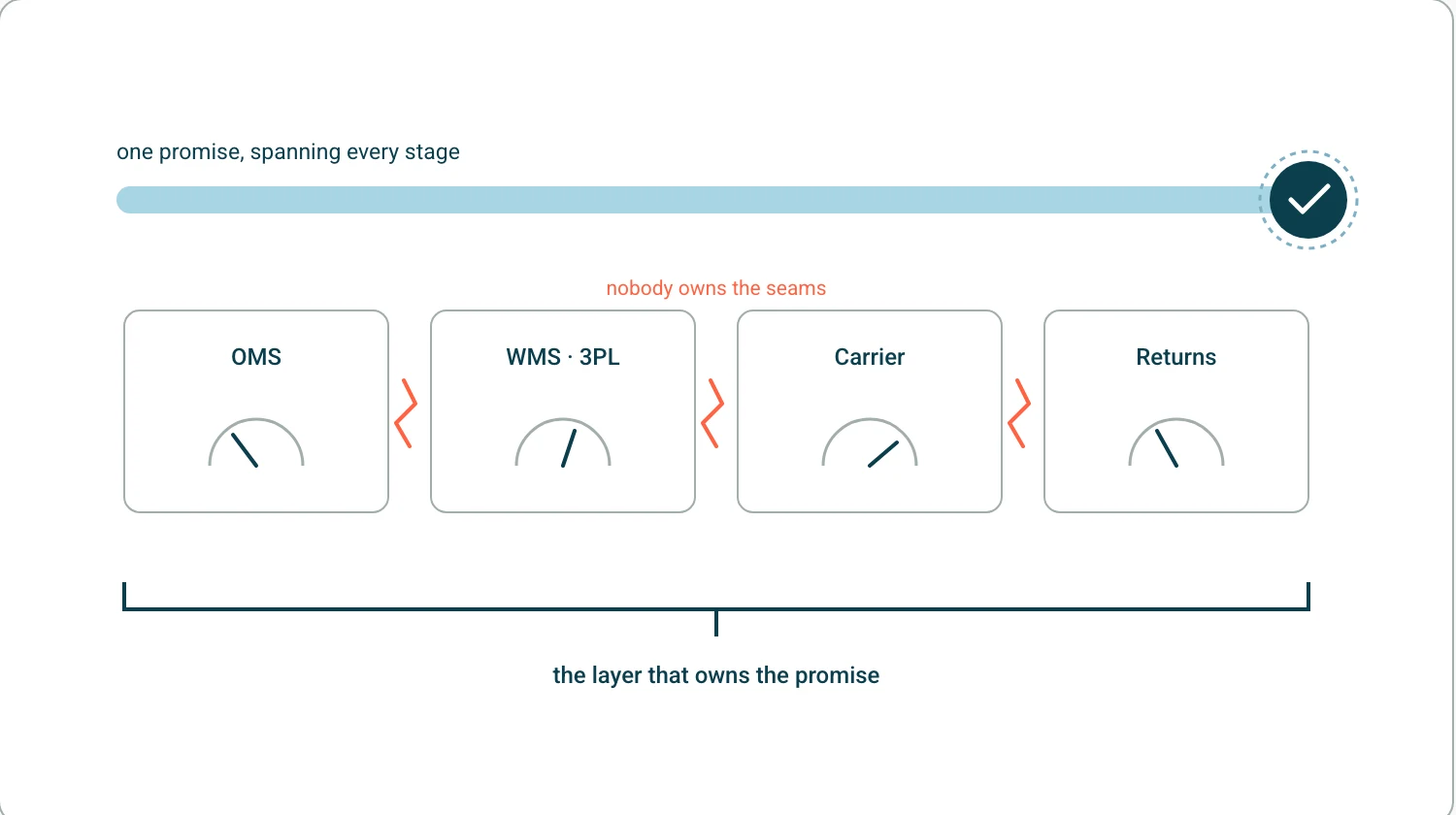
The piece that does not come in a box is the connective tissue. We run 45-plus live integrations across Shopify, Magento, BigCommerce, NetSuite, the 3PL platforms and the marketplaces, with more built, and that depth is what makes an action possible rather than a report, which I described on The Ecommerce Edge. Every system in your diagram assumes someone else is holding the thread between them.
Complexity compounds faster than headcount
Whatever the diagram promises, real systems sprawl. I have seen a CX team of 50 onshore agents managing inquiries across Salesforce Commerce Cloud, Service Cloud, Blue Yonder, and multiple carrier systems, and the sprawl was the job. When IM8 came to us their pain list was the system, not the people: manual regional reporting, no refund tracking, hours of Shopify lookups, a three-way tech stack, disconnected channels, manual Hong Kong operations. And the orders themselves conspire: a customer buys an air fryer and a hair curler that ship from two different suppliers, the order half-fulfills, and now three systems each hold a different truth about one promise. Adding another component to the stack does not fix this, because the failure lives between the components. The habits that keep a sprawling stack honest are on the ecommerce shipping best practices page.
Complexity, not volume, is the real qualifier here. Multiple storefronts, multiple geographies, marketplaces, social channels, pick and pack, ship from store and click and collect are what make this hard, which is the test I use on Marketing for SMEs. A single-store operation does not need another layer. A small team running five channels is already past what headcount can cover.
Peak is when the sprawl stops being theoretical. In the 786 pain points we mined from 270 customer call transcripts between May 2025 and May 2026, Black Friday system sync failures left merchants with zero order visibility and hundreds of unshipped orders they could not see, and 3PLs quietly prioritized new orders over the backlog so the old ones sat until somebody chased. No component in those stacks had failed. The space between them had.
The missing layer: owning the promise
The fix is not a better OMS. It is a layer that stitches every system managing an order into one central view and tracks every order backwards from the promise the customer was given at checkout. It is the same inversion the omnichannel order management page argues for across channels. That inversion matters: internal statuses tell you what a system did, the promise tells you what was supposed to happen and by when. Keeyu is that layer. Tahir, our CTO, describes the build plainly: under the hood we are stitching Shopify, WMS, carriers, returns platforms, and helpdesks into one unified data layer. It watches placed, paid, processed, picked, packed, shipped, delivered, and returned across your OMS, warehouse, 3PL, and carriers, detects the order drifting off its promise, decides the fix, and acts, with your team approving the plays. Detect. Decide. Act. Keeyu gets shoppers what they want, on time, as promised. Whether you run your own shed or three 3PLs, the system of action sits above them all. See it running across a real stack in a demo, start from the definitional ground on the fulfillment page, or zoom out to the post-purchase operations hub. Every order is a promise. Keeyu keeps it, across every system you own and the ones you rent.
The word I use for the missing piece is orchestration. It does not replace the storefront, the order manager, the warehouse system or the carrier integration. It sits across them, holds the customer promise, and when a payment fails or a sync breaks or stock disappears it identifies that in real time and runs the fix. That is how I described it on Marketing for SMEs.
Frequently Asked Questions
What is an order fulfillment system?
The combination of software and services that gets an order from placed to delivered: the OMS that orchestrates orders, the WMS or 3PL that picks and packs, the carriers that deliver, and the integrations tying them to the storefront.
What is the difference between an OMS and a WMS?
An OMS orchestrates orders across channels and locations and decides where each order should be fulfilled. A WMS runs the warehouse floor: bins, pick paths, packing stations. A 3PL bundles the WMS and the labor as an outsourced service.
Should I run my own fulfillment or outsource to a 3PL?
Volume, SKU complexity, and control decide it. Outsourcing removes the warehouse and its systems but adds a party to your stack, and every added party is another place an order can silently stall. Whichever you choose, keep one view that watches every order across all of it.
References
- Keeyu customer results: keeyu.com/customer-stories
- Marketing for SMEs, Jevon Le Roux on the E-Commerce Mistake Costing Millions - the orchestration layer, and the 55% ticket cut at EHP Labs.
- Add To Cart #578, Stop Customer Problems Before They Start: Inside Keeyu's AI Ops - stuck returns, failed payments and orders caught mid-flight.
- The Breakout CEO #86, The Pivot This Founder Made After an Investor Called It Impossible - one in five US shoppers not getting orders on time, and the ticket ratios behind it.
Ready to Stop Reacting?
The fastest way to see how Keeyu prevents complaints is to see it in action.
In one call, we’ll map your current operations, show how our AI Agent fits in, and walk through real examples of issues fixed before customers notice.
Most teams go live within 48 hours. We never share your data.

