
Shipping notifications: what to send, when, and what to say when it breaks
 Verified & Reviewed


 Copy Link
Shipping notifications are the automated messages that track an order's journey to the customer: confirmed, shipped, out for delivery, delivered, and the ones in between. "Where is my order", exchange, and return queries statistically account for around half of all support tickets, and a decent notification cadence deflects the share of those where nothing is actually wrong. The rule I run every brand on, and the standard this whole page applies: tell the customer before they ask. Every time. Every order is a promise. Keeyu keeps it, and a notification is the promise talking to the customer while it is being kept. This page is the playbook: the milestones, the channels, and the messages that matter when things break, which is where proactive e-commerce operations, the system of action for e-commerce, earns its name.
The milestone set worth sending
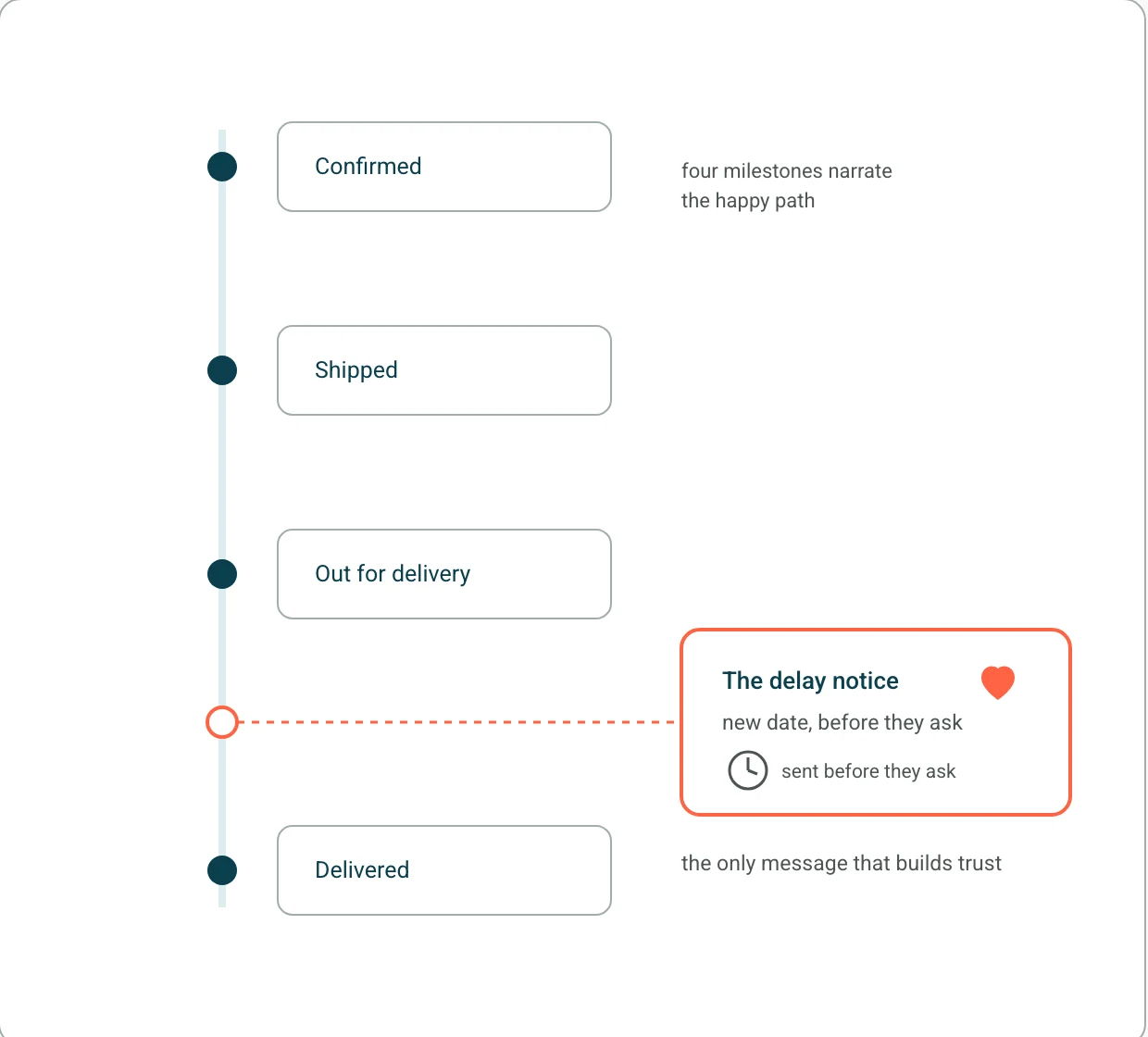
- Order confirmed. Instant, with the delivery promise restated exactly as checkout showed it. This message sets the standard you will be held to.
- Shipped, with tracking. The workhorse. Send it on a real carrier scan, not on label creation, or you are teaching customers that your messages lie.
- Out for delivery. The one customers act on: someone checks the porch, moves the meeting. SMS earns its keep here.
- Delivered. Confirmation plus the next-step path if something is wrong, which quietly deflects the "it says delivered but" ticket.
- The delay notice. The milestone most stores never send, and the only one that builds real trust. If a promise is drifting, say so first, with a new date and what you are doing about it.
Channel split: email carries the record, SMS carries urgency, and the wider automation picture is on the customer service automation page. Send SMS for out-for-delivery and delays, email for everything, and never SMS a milestone the customer cannot act on.
The milestone set is only as good as the promise behind it. We define ours as order before twelve, pay for express, ships same day, arrives tomorrow, then work backwards along every touchpoint against it, which I described on Add To Cart. Send milestones against a promise you can compute and each one confirms something. Send them against a guess and they are just noise with a tracking number attached.
The delay message: the template that matters
Three ready-to-use versions, by scenario, are on the delivery delay templates page.
Three sentences, in this order: we know. Here is the new date. Here is what we are doing about it. That is the whole template, and every word of padding weakens it. What makes it hard is not the copy, it is the trigger: sending this message requires knowing about the delay before the customer does, which is an operations capability, not an email one. This is the line between notification tooling and the layer underneath it, and it is why the delay notice is the milestone that separates brands that narrate from brands that keep promises. The software landscape for the sending side is on the delivery notification software page. The detection side, knowing which orders are drifting off promise, is the on-time delivery discipline.
Notifications matter just as much on the reverse leg: a customer waiting on a refund is a customer waiting on a promise, which the returns management page covers.
Bulk outreach: one message beats fifty tickets
The scale version of tell-them-first: when operations wobble across many orders at once, notify the affected cohort in one move. One of our customers came out of a sale event and accepted and refunded 700 orders in a single action, partially fulfilled orders and shipping thresholds included, with the customer messaging handled as part of the flow. Compare that to the alternative: 700 shoppers discovering the problem one by one and writing in. The same pattern works at every scale. Five returns still sitting unprocessed on the fifth of the month means five refunds late and five complaints brewing: message those five customers before they chase, and the queue never forms. The math is always the same, and I have made the full case for it on The Ecommerce Edge: one proactive message to N customers beats N inbound tickets, and it beats them at the exact moment your team is busiest. The full ticket-cost math is on the WISMO page.
The incident that taught me this was a bulk one. A warehouse sale broke the sync between our storefront and the stock file, a thousand people paid for products that were not there, and every one of them had to be called, credited and apologized to by hand, which I described on Marketing for SMEs. One message sent early would have replaced all of it.
It is the most common shape of failure in the 786 pain points we mined from 270 customer call transcripts between May 2025 and May 2026: after Black Friday, teams sending huge volumes of manual outbound email because nothing in the stack could message everyone affected by one operational problem, and operators saying plainly that manual bulk communication outside a unified system was not sustainable at peak.
Notifications are the voice. Something has to be the hands
Full disclosure on where Keeyu sits in this stack: sending milestone emails is not our core feature, it can be added event-based during scoping. The core is the detection and action underneath, which is the part you cannot bolt on. Everything above assumes you know which orders to message and when, and that is the honest catch: a notification stack is only as good as the detection feeding it. Keeyu watches every order against its checkout promise, catches the drift, fixes what can be fixed, and fires the message as the last step rather than the only step. Detect. Decide. Act. Then tell. Keeyu gets shoppers what they want, on time, as promised, and the notification becomes the receipt for a promise kept rather than an apology in progress. The wider discipline is on the post-purchase operations hub, and a demo shows the detect-to-notify flow on real orders. Every order is a promise. Keeyu keeps it. The notifications are just how the customer hears it happening.
The clean way to say it is read versus write. Notification tools have read access, so they can tell a shopper what happened. The layer above needs read and write into the storefront, the warehouse system and the carrier, so it can cancel, replace, reship and refund. I called that the difference between a system of notification and a system of action on The Ecommerce Edge.
Frequently Asked Questions
Which shipping notifications should an ecommerce store send?
Order confirmed, shipped with tracking, out for delivery, delivered, and - the one most stores skip - the delay notice sent before the customer asks. The delay notice is the one that actually builds trust.
Should shipping notifications go by email or SMS?
Email for the record and the details, SMS for the time-critical moments - out for delivery and delays. SMS open rates earn its cost on messages the customer needs today, not on every milestone.
What should a shipping delay notification say?
Three things: we know, here is the new date, here is what we are doing about it. Sent before the customer asks. A delay the brand announces reads as competence; one the customer discovers reads as a broken promise.
References
- Keeyu customer results: keeyu.com/customer-stories
- The Breakout CEO #86, The Pivot This Founder Made After an Investor Called It Impossible - one in five US shoppers not getting orders on time, and the ticket ratios behind it.
- Add To Cart #599, How to Prevent "Where is my Order?" Complaints Before Customers Ask - preventing "where is my order" before the customer asks.
- Marketing for SMEs, Jevon Le Roux on the E-Commerce Mistake Costing Millions - the orchestration layer, and the 55% ticket cut at EHP Labs.
Ready to Stop Reacting?
The fastest way to see how Keeyu prevents complaints is to see it in action.
In one call, we’ll map your current operations, show how our AI Agent fits in, and walk through real examples of issues fixed before customers notice.
Most teams go live within 48 hours. We never share your data.

