
Order tracking software: what it fixes, and what it only narrates
 Verified & Reviewed


 Copy Link
Order tracking software collects shipment and order status from carriers and your ecommerce stack, then shows it to your team and your customers, usually through a tracking page and automated notifications. For an ecommerce operator the point is not the map with the moving truck. The point is that "where is my order", exchange, and return queries statistically account for around half of all customer support tickets, and tracking software is the first tool most teams reach for to push that number down. My take, after two decades running ecommerce brands: tracking is necessary and not sufficient. Tracking calms customers. It does not fix the order behind the status. Every order is a promise. Keeyu keeps it. Visibility tells you a promise is breaking, and that is where proactive e-commerce operations, the system of action for e-commerce, takes over from software that only narrates.
Cutting WISMO tickets: what tracking actually deflects
A self-serve tracking page and milestone notifications deflect the tickets where nothing is wrong, the customer just wants reassurance. That is a real and worthwhile reduction, and it is why this category of software exists. What is left in the inbox afterwards is the expensive half: the parcel that has not moved in four days, the order stuck unallocated in the warehouse, the split shipment where one box vanished. I have watched a support team spend ten hours clearing a queue of fifty tickets because every single one meant logging into Shopify, the ERP, the warehouse system, and the carrier portal to work out what actually happened. Tracking software shortens the customer's wait for an answer. It does nothing about the team's hunt for one. The full cost math, and what a thousand broken orders taught me about it, is on the WISMO page.
The hunt is where the dataset points too. In the 786 pain points we mined from 270 customer call transcripts between May 2025 and May 2026, tracking sync failures were most often discovered when a customer chased, with an ad-hoc workaround following each one, and tracking feeds taken through an intermediate were routinely four to eight hours behind the carrier. The team was not slow. The data they were hunting through was stale before they opened it.
The reverse leg deserves the same treatment: a tracked return is the other half of the journey, covered on the returns management page.
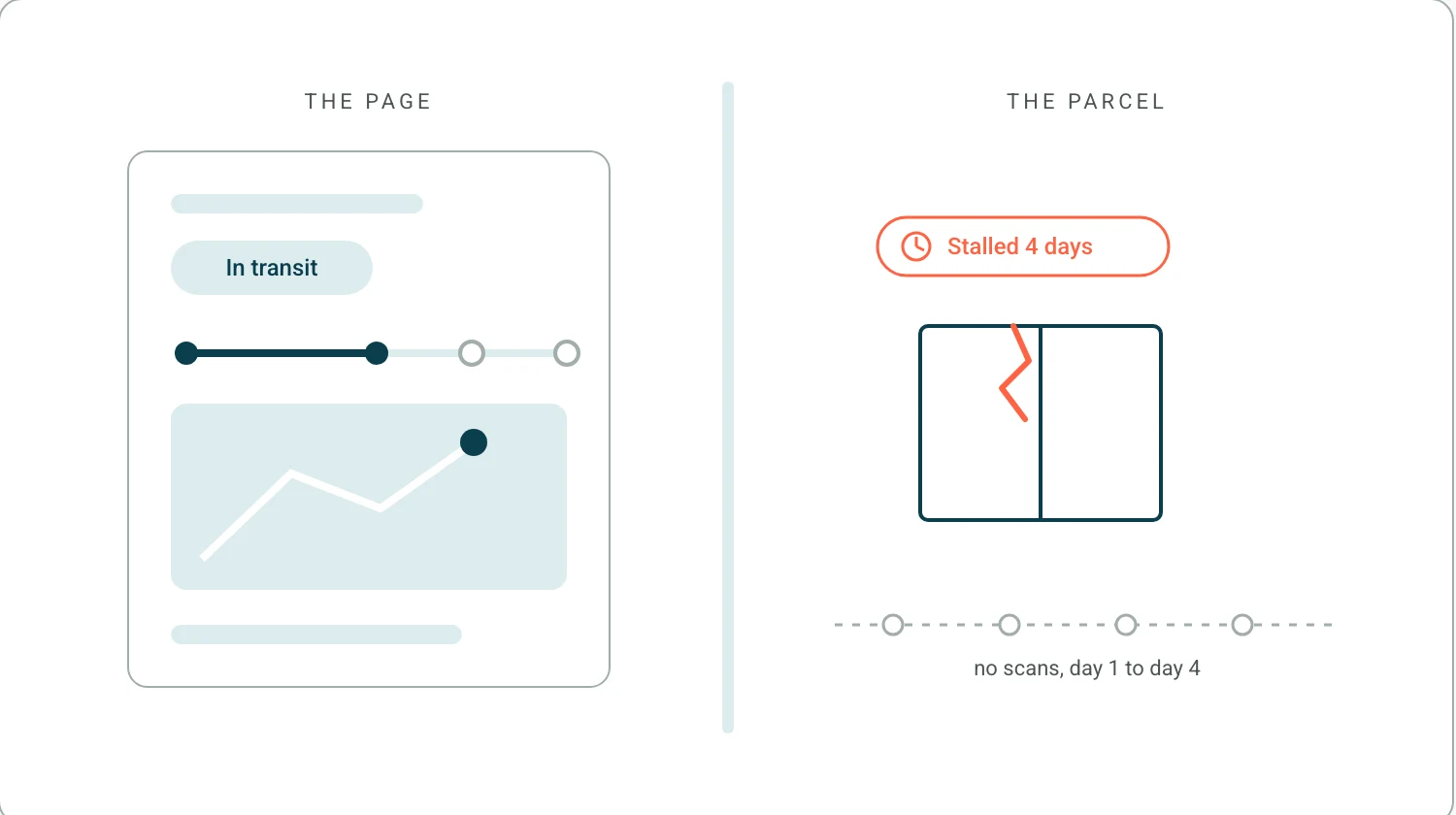
Deflection has a national bill attached. Around 123 million hours went into customer service calls in a single year, which I cited on Add To Cart, and a large share of them started with a shopper who could already see the tracking page and still did not know what was happening. Deflection shortens the call. It does not answer the question the page could not.
A branded post-purchase experience
Branded tracking pages keep the customer on your domain instead of a carrier's, with your look, your recommendations, and your tone. They are worth having: the tracking moment is the most-visited page in the post-purchase journey and handing it to a carrier wastes it. My caution is about what the category sells alongside it. A beautiful tracking page showing a parcel that has been stationary for five days is a beautifully branded broken promise. The page dresses the status. It cannot change it. Get the branded moment, but judge any tool in this space by a harder question: when the status goes bad, does anything happen, or does the customer just watch it go bad in your font?
Multi-carrier and multi-system visibility
Most stores ship with more than one carrier, and the order's truth is scattered wider than that: storefront, payments, warehouse, carrier, returns. Consolidating carrier feeds into one dashboard is table stakes for this software category. The consolidation that actually changes an operator's day goes further back in the journey. I watched one retailer's customer service person alt-tab between 65 open tabs to manage orders across storefronts, warehouses, and carriers. At Helly Hansen, the ecommerce manager was handling support herself, and the single change of being able to paste an order number and see the precise status across every system saved her that tab-hunt on every ticket. That is the standard to hold: one view that covers the whole order journey, placed, paid, picked, packed, shipped, delivered, returned, not just the leg the carrier scans. Shipment tracking starts at the carrier scan, and carrier tracking APIs like the USPS Tracking API return exactly that and no more. Orders break earlier than that.
Proactive exception management: the line that matters
The best tools in this category alert you when a shipment is delayed, stuck in customs, or failing delivery, before the customer notices. This is the feature to weight most heavily, because it is the one that converts tracking from narration into action. For decades, e-commerce teams have used the WISMO query itself as the trigger for fixing operational issues, reactively. Alert-only tools keep that model and just move the trigger earlier. It is also where I part company with most of the category. An alert is still a ticket, just one your team raised instead of the customer. I said this on The Ecommerce Edge and I will say it here. My co-founders and I hold a strong belief that "where is my order" should not exist in the lexicon of customer service, because the best customer service is the kind the customer never needs to contact. That requires the next step after detection: decide and act. When a parcel stops moving past a set threshold, Keeyu identifies it in real time, proactively notifies the customer, raises a replacement on express with a new tracking number, and files the claim, without a human queuing the work. Merchants running this see up to 90% fewer WISMO tickets, 50% lower support costs, and 70% faster resolution. Keeyu gets shoppers what they want, on time, as promised. Delay detection depends on knowing the promise, which is why the software should track orders against "order before 12, ships same day", not against internal statuses. More on that on the on-time delivery page.
Ask any vendor what happens at amber. We score every order against the promise made at checkout, blue while it is on plan, amber when it is about to breach, red when it has, and the workflow fires at amber, which I explained on Add To Cart. Software that only turns red is a reporting tool. The window where a fix still beats a ticket is the amber one.
Choosing: free tools, tracking suites, and systems of action
An honest map of the landscape, including the free end, since that is where most teams start.
- Free order tracking. Carrier pages, your platform's native order status page, and consumer parcel apps cost nothing and answer "where is it" for one parcel at a time. Shopify's native tracking, covered on the Shopify order tracking page, is genuinely fine for a young store. Free tools show status. None of them watch your whole order book or act on a stalled order.
- Tracking and notification suites. Branded pages, multi-carrier dashboards, milestone emails and SMS. Consumer-grade equivalents are covered on the package tracking app page. These reduce the reassurance tickets and improve the post-purchase moment. They stop at telling.
- Proactive e-commerce operations. The system of action: detect the breaking promise across every connected system, decide the fix, act on it, with your team approving the plays. This is the category Keeyu built, and you can see it against your own stack in a demo. We run a paid proof of concept with a double money-back guarantee in the first 30 days, month to month, no lock-in, because the category is new and I would rather prove it on your orders than argue it on a call.
Delivery exceptions deserve their own decision framework, which lives on the delivery exception page, and the whole discipline this page sits inside is mapped on the post-purchase operations hub.
One number makes this a budget conversation rather than a philosophical one. Take a brand at a hundred thousand orders a year and ten thousand tickets, prevent half of those, and price what those shoppers were worth at your own average order value and repeat rate, which is the calculation I ran on eCommerce Australia. Then compare it to what your tracking suite costs. The gap is the case for the layer above it.
The bottom line
Buy tracking software for what it genuinely does: deflect reassurance tickets, own the branded tracking moment, and consolidate carrier chaos into one view. Then be clear-eyed that every order it shows you is a promise you made at checkout, and a status page keeps no promises. Something has to catch the order that is quietly going wrong and fix it before your customer feels it. Every order is a promise. Keeyu keeps it. See how merchants like EHP Labs run it in our customer stories.
Frequently Asked Questions
What is order tracking software?
Software that aggregates shipment status from carriers and shows it to the merchant and the customer, usually through a tracking page and automated notifications. It reduces "where is my order" contact volume by making status visible before the customer has to ask.
Is there free order tracking software?
Yes. Carrier tracking pages are free, most ecommerce platforms include basic order status pages, and consumer tools track individual parcels at no cost. Free tools show status. They do not detect stalled orders across your whole book or act on them.
What is the difference between order tracking and shipment tracking?
Shipment tracking starts when the carrier scans the parcel. Order tracking covers the whole promise - placed, paid, picked, packed, shipped, delivered, returned - including the warehouse stages a carrier never sees.
How does order tracking software reduce WISMO tickets?
By answering the question before it gets asked - proactive notifications and a self-serve tracking page typically remove a large share of status inquiries. The remaining tickets are the ones where something actually went wrong, which visibility alone cannot fix.
References
- Jevon Le Roux on why WISMO should not exist, podcast interview: YouTube
- Keeyu customer results (EHP Labs and others): keeyu.com/customer-stories
- The Breakout CEO #86, The Pivot This Founder Made After an Investor Called It Impossible - one in five US shoppers not getting orders on time, and the ticket ratios behind it.
- Add To Cart #599, How to Prevent "Where is my Order?" Complaints Before Customers Ask - preventing "where is my order" before the customer asks.
- Marketing for SMEs, Jevon Le Roux on the E-Commerce Mistake Costing Millions - the orchestration layer, and the 55% ticket cut at EHP Labs.
Ready to Stop Reacting?
The fastest way to see how Keeyu prevents complaints is to see it in action.
In one call, we’ll map your current operations, show how our AI Agent fits in, and walk through real examples of issues fixed before customers notice.
Most teams go live within 48 hours. We never share your data.

