
Order management software: evaluate it on the failure path
 Verified & Reviewed


 Copy Link
What order management software does
Order management software captures orders from your sales channels, allocates inventory against them, routes them to a fulfillment location, and tracks their status through to delivery. Buyers usually evaluate it on channel coverage, inventory accuracy, warehouse and 3PL integrations, returns handling and reporting.
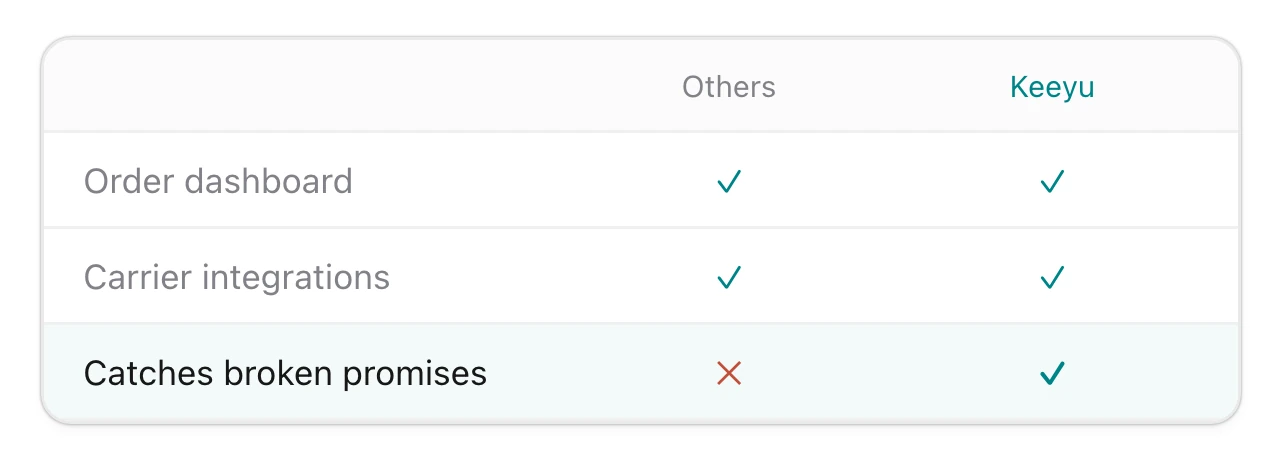
Those are the right features to compare. The thing that rarely appears on the comparison grid is what the software does when an order stops moving, and that is where the operational cost lives.
Every order is a promise. Keeyu keeps it. Order management software records the promise. It is usually silent when one breaks.
Evaluate it on the failure path, not the happy path
Every product in this category handles a clean order well. Order comes in, stock allocates, warehouse picks, carrier delivers. Differences show up on the exception path, which is what actually consumes your team's time.
Questions worth asking in a demo:
- What happens when an order does not reach the warehouse system at all?
- How do I find every order that has not progressed in the last 48 hours?
- Where does a fulfillment hold surface, and who gets told?
- What happens when stock sells that does not exist?
- Can it act on a stalled order, or only display it?
Most tools answer the display questions well and the action questions not at all.
There is a distinction I use in every evaluation, and it decides most of them. A system of record processes the transaction. A system of notification tells someone that something happened, and it is read only. A system of action detects, notifies and writes back into the systems that own the order. I laid that out on The Ecommerce Edge. Most order management software is the first kind, most post-purchase apps are the second, and the failure path needs the third.
The failure mode that no single system catches
I watched a customer service person at a retailer work with 65 tabs open, moving between storefronts, warehouses, carriers and ERP locations to answer order questions. Every one of those systems was functioning. The gap was that none of them held the whole picture and stitching them together was manual.
At the start of COVID in 2020 our warehouse sale revenue skyrocketed and Shopify stopped syncing orders with the warehouse. It oversold, and we finished with a thousand orders for stock that did not exist. The store was fine, the warehouse system was fine, the connection between them was not, and nothing raised an alarm.
These are integration failures rather than software failures, which is exactly why buying a better system of record does not resolve them.
Integration reality
Assume some part of your stack has no usable API. It is extremely common in warehouses and with regional carriers. We lost two customers because we could not integrate with their systems, so our CTO Tahir built browser operator functionality that lets Keeyu work through the browser and read data from systems that were never built to be automated.
Our workaround for exactly that gap is a browser operator: AI that opens the browser, reviews the information, takes photographs, and converts them into usable data. It constantly scans carrier portals like Royal Mail, and it is how we cover a Sydney 3PL notorious for giving nobody API access.
When you evaluate order management software, ask what happens with the one system in your stack that has no modern API. That answer determines whether you get real coverage or a well-integrated blind spot.
The honest number here is time, not features. We run more than fifty integrations and the reason that took a team of engineers over a year is that no two retailers carry the same stack, which I talked through on Add To Cart. When you scope any integration project, ask for the two dates that matter: how many hours of your team's time it costs up front, and what happens when a system on the list is one the vendor has never connected to before.
The layer above the software
What is missing in most stacks is not another system of record but a system of action: something that knows what each order should be doing right now, notices when it stops, and does something about it.
At EHP Labs an out-of-stock workflow that took 45 minutes now runs in five, and their CX team went from 18 people to 8. At Clutch Glue we caught 70 US orders that had not synced and had gone three days without shipping.
The workflow behind that number: triggered when the warehouse types 'out of stock' into NetSuite, it searches other stores for inventory, finds product alternatives, checks the ERP for next shipments, and if no replacement stock exists, cancels the order and processes the refund.
That is proactive e-commerce operations. Detect. Decide. Act. The customer gets what they want, on time, as promised.
That layer operates where helpdesk AI cannot reach: Return to Sender, Lost in Transit, awaiting collection, out-of-stock, resolved end-to-end before a ticket exists.
See how the workflows run or book a demo.
Cost this layer against the staffing it removes. One of our customers runs twenty support people year round and scales to forty for two months around peak, a number I gave on eCommerce Australia. Order management software does not change that second figure. Something that detects and fixes the underlying failures does.
Related reading
For the system category itself, read order management system. For fulfillment, see fulfillment. For the operational layer, read post-purchase operations.
Frequently Asked Questions
What is the best order management software?
Evaluate on the failure path, not the feature grid: what happens when an order does not reach the warehouse, how you find every order that has not moved, and what the software does about it. Every product handles the happy path. The failure path is where they separate.
Is there good free order management software?
Platform built-ins cover the basics: Shopify's order admin records, allocates and reports. The gap in every tier, free or enterprise, is the watching: no built-in tells you an order quietly stopped moving between systems.
References
- SCOR Digital Standard, RS.1.1 Order Fulfillment Cycle Time: order fulfillment cycle time, the standard measure.
- DeHoratius and Raman, Management Science, on inventory record inaccuracy: inventory records are wrong more often than the OMS assumes.
- Marketing for SMEs, Jevon Le Roux on the E-Commerce Mistake Costing Millions - the orchestration layer, and the 55% ticket cut at EHP Labs.
- Add To Cart #578, Stop Customer Problems Before They Start: Inside Keeyu's AI Ops - stuck returns, failed payments and orders caught mid-flight.
- The Breakout CEO #86, The Pivot This Founder Made After an Investor Called It Impossible - one in five US shoppers not getting orders on time, and the ticket ratios behind it.
Ready to Stop Reacting?
The fastest way to see how Keeyu prevents complaints is to see it in action.
In one call, we’ll map your current operations, show how our AI Agent fits in, and walk through real examples of issues fixed before customers notice.
Most teams go live within 48 hours. We never share your data.

